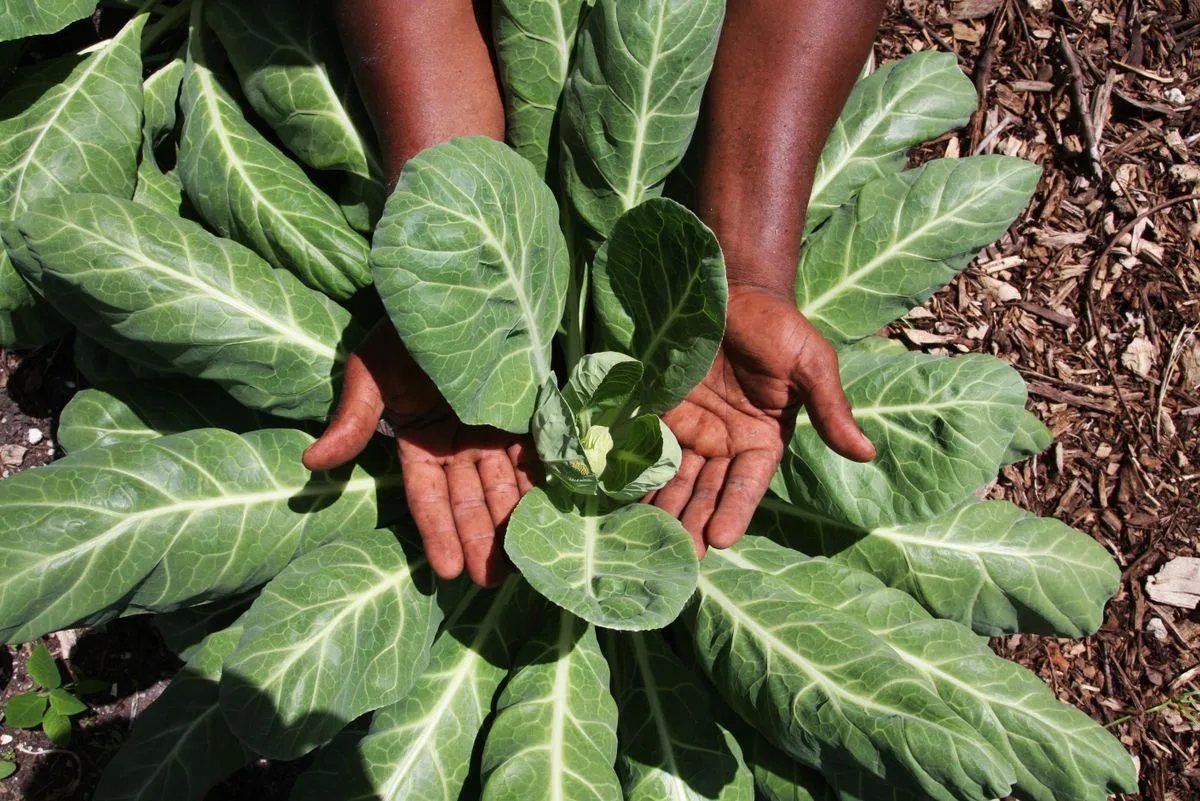
Leafy Greens
Collard Greens
Planned crop · UCFarms is still building the farm
Large, flat leaves related to kale. A staple green that holds its shape through long, slow cooking.
Farm to table
Production StandardsHow collard greens would get from the farm to you.
- GrownIn a controlled environment.
- HarvestedIn small batches, kept separate.
- TestedBy an independent lab.
- TrackedEvery harvest labeled.
- DeliveredWith the batch label intact.
What’s inside collard greens.
A snapshot of why this crop is nutritionally interesting. Choose a nutrient to follow it into the body, then come back here.
Based on USDA’s collards, raw reference, per 100 g. This describes the reference food; it is not a measurement of a UCFarms harvest. Reference details
See every nutrient in collard greens on one chart in the Atlas
Reference nutrient amounts
Reference food: Collards, raw, USDA FoodData Central (SR Legacy, FDC ID 170406). These are reference values for the food, not measurements of a UCFarms harvest.
Reference data
Explore Atlas sources & evidence
Sources & references (25)
- Spinach, raw, USDA FoodData Central 168462 · U.S. Department of AgricultureSelected nutrient amounts per 100 g raw edible spinach. Reference food, not a UCFarms harvest measurement.Source details in the Atlas: Spinach, raw, USDA FoodData Central 168462Verified from the official SR Legacy JSON download. The exact food record and source calculation are available in the crop reference profiles below.https://fdc.nal.usda.gov/fdc-datasets/FoodData_Central_sr_legacy_food_json_2018-04.zip
- Collards, raw, USDA FoodData Central 170406 · U.S. Department of AgricultureSelected nutrient amounts per 100 g raw edible collard greens. Reference food, not a UCFarms harvest measurement.Source details in the Atlas: Collards, raw, USDA FoodData Central 170406Verified from the official SR Legacy JSON download. The exact food record and source calculation are available in the crop reference profiles below.https://fdc.nal.usda.gov/fdc-datasets/FoodData_Central_sr_legacy_food_json_2018-04.zip
- Watercress, raw, USDA FoodData Central 170068 · U.S. Department of AgricultureSelected nutrient amounts per 100 g raw edible watercress. Reference food, not a UCFarms harvest measurement.Source details in the Atlas: Watercress, raw, USDA FoodData Central 170068Verified from the official SR Legacy JSON download. The exact food record and source calculation are available in the crop reference profiles below.https://fdc.nal.usda.gov/fdc-datasets/FoodData_Central_sr_legacy_food_json_2018-04.zip
- Basil, fresh, USDA FoodData Central 172232 · U.S. Department of AgricultureSelected nutrient amounts per 100 g raw edible basil. Reference food, not a UCFarms harvest measurement.Source details in the Atlas: Basil, fresh, USDA FoodData Central 172232Verified from the official SR Legacy JSON download. The exact food record and source calculation are available in the crop reference profiles below.https://fdc.nal.usda.gov/fdc-datasets/FoodData_Central_sr_legacy_food_json_2018-04.zip
- Strawberries, raw, USDA FoodData Central 167762 · U.S. Department of AgricultureSelected nutrient amounts per 100 g raw edible strawberries. Reference food, not a UCFarms harvest measurement.Source details in the Atlas: Strawberries, raw, USDA FoodData Central 167762Verified from the official SR Legacy JSON download. The exact food record and source calculation are available in the crop reference profiles below.https://fdc.nal.usda.gov/fdc-datasets/FoodData_Central_sr_legacy_food_json_2018-04.zip
- Mushrooms, oyster, raw, USDA FoodData Central 168580 · U.S. Department of AgricultureSelected nutrient amounts per 100 g raw edible oyster mushroom. Reference food, not a UCFarms harvest measurement.Source details in the Atlas: Mushrooms, oyster, raw, USDA FoodData Central 168580Verified from the official SR Legacy JSON download. The exact food record and source calculation are available in the crop reference profiles below.https://fdc.nal.usda.gov/fdc-datasets/FoodData_Central_sr_legacy_food_json_2018-04.zip
- Kale, raw: FoodData Central 323505 · USDA Agricultural Research ServiceReference nutrient composition of raw kale, per 100 g edible portion.Source details in the Atlas: Kale, raw: FoodData Central 323505The audit used USDA’s Foundation Foods download. If this record link is unavailable, use the dataset or saved record below.https://fdc.nal.usda.gov/food-details/323505/nutrients
- Daily Value on the Nutrition and Supplement Facts Labels · U.S. Food and Drug AdministrationFDA Daily Values (adults and children 4+) used to compute % DV.Source details in the Atlas: Daily Value on the Nutrition and Supplement Facts Labelshttps://www.fda.gov/food/nutrition-facts-label/daily-value-nutrition-and-supplement-facts-labels
- Vitamin K: Fact Sheet for Health Professionals · National Institutes of Health, Office of Dietary SupplementsVitamin K's role in normal blood coagulation and bone protein metabolism.Source details in the Atlas: Vitamin K: Fact Sheet for Health Professionalshttps://ods.od.nih.gov/factsheets/VitaminK-HealthProfessional/
- Vitamin C: Fact Sheet for Health Professionals · National Institutes of Health, Office of Dietary SupplementsVitamin C's role in collagen synthesis, physiological antioxidant activity and immune function.Source details in the Atlas: Vitamin C: Fact Sheet for Health Professionalshttps://ods.od.nih.gov/factsheets/VitaminC-HealthProfessional/
- Vitamin A and Carotenoids: Fact Sheet for Health Professionals · National Institutes of Health, Office of Dietary SupplementsVitamin A's role in vision, immune function and cellular differentiation; provitamin-A vs non-provitamin-A carotenoids.Source details in the Atlas: Vitamin A and Carotenoids: Fact Sheet for Health Professionalshttps://ods.od.nih.gov/factsheets/VitaminA-HealthProfessional/
- Folate: Fact Sheet for Health Professionals · National Institutes of Health, Office of Dietary SupplementsFolate's role in DNA/RNA synthesis, amino-acid metabolism and cell division; Dietary Folate Equivalents.Source details in the Atlas: Folate: Fact Sheet for Health Professionalshttps://ods.od.nih.gov/factsheets/Folate-HealthProfessional/
- Manganese: Fact Sheet for Health Professionals · National Institutes of Health, Office of Dietary SupplementsManganese as an enzyme cofactor.Source details in the Atlas: Manganese: Fact Sheet for Health Professionalshttps://ods.od.nih.gov/factsheets/Manganese-HealthProfessional/
- Calcium: Fact Sheet for Health Professionals · National Institutes of Health, Office of Dietary SupplementsCalcium's role in bone structure, muscle function and nerve transmission.Source details in the Atlas: Calcium: Fact Sheet for Health Professionalshttps://ods.od.nih.gov/factsheets/Calcium-HealthProfessional/
- Vitamin B6: Fact Sheet for Health Professionals · National Institutes of Health, Office of Dietary SupplementsVitamin B6's role in metabolic and neurological functions.Source details in the Atlas: Vitamin B6: Fact Sheet for Health Professionalshttps://ods.od.nih.gov/factsheets/VitaminB6-HealthProfessional/
- Iron: Fact Sheet for Health Professionals · National Institutes of Health, Office of Dietary SupplementsIron's role in hemoglobin and myoglobin oxygen transport.Source details in the Atlas: Iron: Fact Sheet for Health Professionalshttps://ods.od.nih.gov/factsheets/Iron-HealthProfessional/
- Magnesium: Fact Sheet for Health Professionals · National Institutes of Health, Office of Dietary SupplementsMagnesium's role as an enzyme cofactor and in nerve, muscle and heart-rhythm function.Source details in the Atlas: Magnesium: Fact Sheet for Health Professionalshttps://ods.od.nih.gov/factsheets/magnesium-HealthProfessional/
- Potassium: Fact Sheet for Health Professionals · National Institutes of Health, Office of Dietary SupplementsPotassium's role in electrochemical gradients, nerve transmission, muscle contraction and heart function.Source details in the Atlas: Potassium: Fact Sheet for Health Professionalshttps://ods.od.nih.gov/factsheets/Potassium-HealthProfessional/
- Got Calcium? · U.S. government sourceSource details in the Atlas: Got Calcium?https://www.nigms.nih.gov/biobeat/2023/02/got-calcium
- Dietary Fiber: Interactive Nutrition Facts Label · U.S. government sourceSource details in the Atlas: Dietary Fiber: Interactive Nutrition Facts Labelhttps://www.accessdata.fda.gov/scripts/interactivenutritionfactslabel/assets/InteractiveNFL_DietaryFiber_October2021.pdf
- Foundation Foods JSON release 2026-04-30 · USDA Agricultural Research ServiceSource details in the Atlas: Foundation Foods JSON release 2026-04-30https://fdc.nal.usda.gov/fdc-datasets/FoodData_Central_foundation_food_json_2026-04-30.zip
- Foundation Foods Documentation · USDA Agricultural Research ServiceSource details in the Atlas: Foundation Foods Documentationhttps://fdc.nal.usda.gov/Foundation_Foods_Documentation/
- Vitamin C: Medical Encyclopedia · National Library of Medicine, MedlinePlusVitamin C, collagen and the growth and repair of skin, tendons, ligaments and blood vessels.Source details in the Atlas: Vitamin C: Medical Encyclopediahttps://medlineplus.gov/ency/article/002404.htm
- Vitamin A: Medical Encyclopedia · National Library of Medicine, MedlinePlusVitamin A helps form and maintain teeth, skeletal and soft tissue, mucous membranes and skin.Source details in the Atlas: Vitamin A: Medical EncyclopediaFunction section: "Vitamin A helps form and maintain healthy teeth, skeletal and soft tissue, mucus membranes, and skin." Reviewed 1/21/2025.https://medlineplus.gov/ency/article/002400.htm
- Dietary Supplements for Immune Function and Infectious Diseases · National Institutes of Health, Office of Dietary SupplementsVitamin A and vitamin C roles in tissue barriers and immune-cell function; distinct from evidence that supplements prevent or treat infections.Source details in the Atlas: Dietary Supplements for Immune Function and Infectious DiseasesTeaching locators: Vitamins and minerals sections, Vitamin A and Vitamin C introductions.https://ods.od.nih.gov/factsheets/ImmuneFunction-HealthProfessional/
How it supports the body.
Nutrients in collard greens play a role in these systems. Each one opens in the Atlas with its sources.
- Brain & Nervous SystemThe brain, spinal cord and nerves that carry signals through the body.
- Immune SystemThe cells and tissues that recognize and respond to what shouldn't be there.
- Cardiovascular SystemThe heart and blood vessels that move oxygen and nutrients around the body.
- Musculoskeletal SystemBones, muscles and connective tissue: structure and movement.
- SkinYour body's outer covering, also called the integumentary system. It holds fluids in, keeps out germs, lets you feel heat, cold and pain, and helps control body temperature.